Wednesday, July 28, 2010

The Big Blue Button- free webinar platform

Hat tip to Don Christie for bringing this to my attention: http://bigbluebutton.org/overview
The big blue button is a collection of 14 different open source tools that allow teachers and learners to collaborate in online classes. It features video and audio conferencing, application sharing and chat. From what I've seen, it's absolutely amazing. I'll get some of our students to install it so we can have a play.

Thursday, July 22, 2010

The iPad launches today in NZ

This just in: Apple unveils a new feature in its stores: The Friend Bar.

New Apple Friend Bar Gives Customers Someone To Talk At About Mac Products

While a lot of people are buzzing about this device being the next big thing, I'm a bit more hesitant. As Tim Lee says, moving to more of a closed, locked down operating system, seems to go against the current trends in computing. (RMS calls it the iBad).
I still prefer the Dell Streak for the fact that it runs Android.

Saturday, July 10, 2010

Moodle 2.0 - conditional activities

Moodle 2.0 has been a long time coming: it's been two years in development, 70% of the code has been re-written and some great new features have been added.
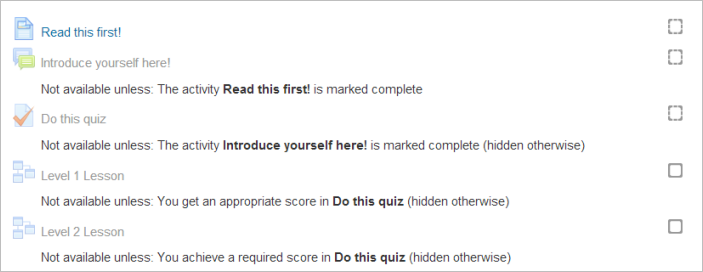
One of the most transformational is what they're calling 'conditional activities'. There has been a bit of debate over whether conditional activities should be added to Moodle because some believe that every student should have access to all learning activities at all times (a viewpoint that has considerable merit) but I'm in favour of conditional activities because it gives educators the ability to reconfigure the learning management system depending on the needs of the learner. In short: Moodle becomes a personalised learning environment.
Image a situation whereby a student gets 100% in the diagnostic assessment at the start of a unit of work, while another gets 20%. These two students need dramatically different pathways through the topic ahead, but traditionally they have had the same materials available to them from this point on. Using conditional activities, a teacher could say "If a student receives 80% or higher in this quiz, then reveal to them these further activities, but if a student receives 20% or lower, allow them to see these activities..." Teachers can set any criteria they like around turning these activities on or off, but used well, this has the power to put the right learning activity in front of the right learner at just the right time. I can't wait to start using them with my students...

Sunday, July 4, 2010

Stop motion animation with Luciole

A couple of students came to me recently to explain that they needed help with (what appeared to be) a really complicated process for creating stop-motion animations. They were doing something in Photoshop with some proprietary plugin that could only run on a particular computer, and were unable to bring that computer to school. It got me thinking: the process of creating stop-motion animation is not complicated, so surely there must be some easy-to-use software out there for creating animations. The short answer is: there is.
I installed Luciole from the Ubuntu repository (took me 30 seconds to download and install) and it turned my laptop into Peter Jackson's studio. Thankfully it was wet last weekend, so I turned the kitchen table into a brickfilms stage. My first effort was far from interesting (my wife just frowned and shook her head when she saw it) but now I can't wait until my son is old enough to make films with. I'm sure, however, that in the tradition of train sets and meccano, the grown-up will have more fun than the child.
And if that isn't enough to encourage you to try it out, would break dancing plasticine men convince you?

I chose to be a bit less ambitious with my first attempt:

Sunday, June 27, 2010

Software patents coming to NZ

Further to my post last month, it appears the NZ government has done a u-turn on software patents and has decided, in the face of plenty of evidence to the contrary, we need them after all. What I found most surprising is the relative speed with which MP Simon Power did his flip flop. Going against a long and considered select committee process, Power was swayed by a guy who appears to be happy to admit that he doesn't know much about SW patents, and that, in fact, he is "not well informed on the software patents issue - he had his PA prepare his briefing on it."

Nice Linux ad

Wow. What a busy term. More posts to come, but in the meantime, here's some nice, open eye-candy:

The Origin... from Agustin Eguia on Vimeo.

(Thanks to cyberkiller.)

Sunday, May 16, 2010

Software patents

One of the biggest threats to free and open source software at the moment is the existence of software patents. News came out recently that not only is Apple suing HTC over its smartphones, but Steve Jobs also has his eyes on the brilliant open source video format Ogg Theora. Essentially what companies like Apple want is for everyone in the computing world to use the product they developed and to pay them a royalty for the privilege of using them. Clearly community-owned assets like open source software gets in the way of this kind of monopoly. Software patents are anti-competitive and unethical for a number of reasons, including:
  • They are designed to protect an individual's or an individual company's 'intellectual property'. It's not designed to protect public ownership of things.
  • They are designed to protect incumbents. Companies with good lawyers and deep pockets are collecting patents on just about everything to do with computing at the moment. If young, innovative companies want to make any progress in this kind of market, they have to sell their soul to incumbents before they begin.
  • They make lawyers wealthy at the expense of entrepreneurs.
...and if a company like Microsoft can patent something like the double click, we might as well all get out of computing before we all get sued.